New Movie: Off the Rez
by Sam Riches / @sam_riches
Shoni Schimmel streaks down the left side of the court, her long brown ponytail bouncing in the air behind her. At full speed, she uses her right hand to wrap the ball behind her back and through her legs, before gently laying it off the backboard with her left. Her defenders, now a few steps behind her, never stood a chance.
Schimmel is from the Umatilla Indian Reservation in Oregon. Situated a few miles outside of Pendleton and just north of the Blue Mountains; Umatilla is home to around three thousand Native Americans. For Shoni, it is also her proving ground. She plays ‘rez ball,’ a ferocious, attacking style of basketball, fueled by passion, creativity and relentless aggressiveness. It is this flare and fearlessness that has resulted in many declaring Schimmel the second coming of Pistol Pete Maravich. A comparison that, while initially seeming improbable, is startlingly accurate.
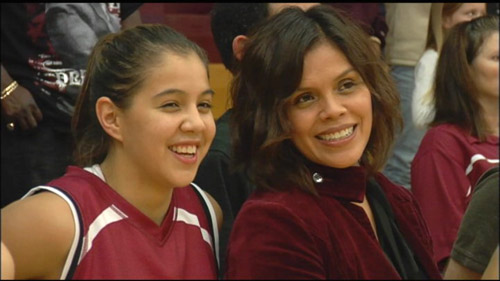
With her junior year approaching, Shoni’s mother, Ceci, (they are left to right in photo) was offered a coaching position at Portland’s Franklin high school. Seeing this as an opportunity to chase a dream and battle against generations of oppression and bigotry, Shoni and her family leave the reservation and embark on a battle that tests their strength, spirit and tenacity.
Eight-time Emmy award winner and long-time friend of SLAM’s, Jonathan Hock (learn more about him at hockfilms.com) documents the journey in Off the Rez and caught up with SLAM this past week.
SLAM: You’ve done work in baseball, football and wrestling, but the majority of your work has been focused on basketball, why is your passion so strong for the sport?
Jonathan Hock: Basketball players aren’t hidden behind helmets like football players, or are a mile away from you on the field like baseball players. It’s a sport where a player’s passion is so close at hand, and when the stakes for are so high for the player and her family, as they are for Shoni or as they were for Sebastian and his family in Through the Fire, that other sports can’t match it.
SLAM: How did you first hear about Shoni?
JH: Nelson Hernandez, who became a producer on the film, was a graduate of Lincoln High School and a fan of Through the Fire. He was out west running a Native American youth organization, and with basketball as big in Indian Country as it is in the hood, he was very plugged into the incredible talent in the Native American community. In the aftermath of the terrible killings at the Red Lake Reservation in Minnesota, Nelson was organizing a youth conference there and got in touch with me to ask if he could show “Through the Fire” at the conference as an inspiration to the kids. A couple of years later, Nelson told me that he had found the next Through the Fire story on a reservation in Oregon. I flew out to meet Shoni and her family, and found the same love and passion in them—and the same kind of incredible basketball genius in the high school player—as we found in Coney Island.
SLAM: The film captures the struggles faced by the family and the tenacity and courage it takes to pack up and move in hopes of achieving a goal – where does that courage stem from?
JH: Shoni clearly draws courage from her mom, Ceci Moses. Ceci is has a strong, clear-headed awareness of how history and society are aligned against her people, in obvious ways and in more subtle ways that people from the “outside world” don’t really notice. But Ceci does not back down when she confronts adversity—sometimes it seems like she’s trying to undo 400 years of oppression every game—and I don’t think Shoni knows how to back down either.”
SLAM: Did you see similarities in the social and economic challenges faced by Shoni and her family in comparison to the issues faced by Sebastian Telfair and his family in Through the Fire?
JH: I think our society as a whole is set up in a way to keep the people oppressed on the reservation and in the inner city ghettos. Geographically, psychologically, economically, the system that we operate under is set up to keep those people there while the people with the resources and the power keep what they have. In recent decades, people in the hood have been able to break out of the invisible walls that enclose the ghettos, though the odds against them are still huge. On the reservation, the invisible wall that separates them from the outside world is even more impenetrable. So to try to break out of the psychological and economic confines of the reservation is so difficult, especially if you want to do it on your own terms, without compromising who you are or what you represent. That’s what Shoni’s family was trying to do, and it was very inspiring to watch.
SLAM: When you first approached Shoni and her family, were they receptive to the idea or did it take some convincing?
JH: They were receptive to the idea of spreading a good message for their people,but there was some level of distrust that had to be overcome. Here’s a white guy from the east coast and I’m not sure it was easy for them to trust me. Historically, they certainly had every justification to be suspicious. But as a filmmaker I believe you try to let your empathy for the subject guide you—you don’t impose some pre-ordained ideology or let some political agenda box you into your story. We were open to their truth, and after a while they came to understand that on some level, I think, and we were able to break through.
SLAM: Was that initial distrust the biggest obstacle you faced in making this film?
JH: I think so. You need your subject to trust you when your sitting in their living room or kitchen or locker room with a camera.
SLAM: How important is basketball for the youth on the reservations?
JH: On the rez, they talk about basketball as a way to battle for their tribe’s dignity. To take your best five and travel to another reservation or take on some team from the outside, that’s a tremendous source of pride for them. And it makes the game matter so much.
SLAM: Why did you want to tell this story?
JH: Partly, I wanted to shine a light on the forgotten hood. The reservation is just another manifestation of the hood in America, only it exists so far out of the light of the mainstream that people don’t know about it. I didn’t know much about it, but I was curious, and I found a family that believed in something and was trying to accomplish something I could relate to. So I just stayed with it and now, two and a half years later, we have the movie.
SLAM: Are you still in contact with Shoni?
JH: Oh yeah, we went down to see her at Louisville and shoot a little this season, and I speak with her dad Rick regularly. You don’t put the cameras down and just move on. I actually was just exchanging text messages with Jamel Thomas, Sebastian’s brother, this morning, and we stopped filming Through the Fire in 2004. You develop a relationship when you work with people and when you respect them and they respect you, the relationship doesn’t end the day you stop production.
SLAM: Because of the intimate nature of making a documentary, do you find you have to try and emotionally remove yourself from the process?
JH: The opposite actually. Don’t be afraid to let your emotions be present when you shoot. Steve Sabol, my mentor at NFL Films, taught me not to be afraid to feel deeply for your subject. Follow your heart when you shoot, not your head, and you’ll get at a deeper truth.
Off the Rez is a richly layered film, one that captures the emotional toll of an athlete carrying the hopes of a community while also being part of a family struggling to make ends meet. The film offers a glimpse into the realities of being a member of an often overlooked minority and touches on universal themes of equality and subjugation, while also providing an inside perspective to the realities of being one of the best high school basketball players in America.
Off the Rez will be debuting at the Tribeca Film Festival tomorrow, April 26th and premiering on TLC Saturday May 14 at 9 p.m. EDT.