Saturday, October 16th, 2010 at 6:57 pm  |  20 responses

Dean Oliver on Quantitative Analysis

Oliver talks about the role his statistical analysis plays in the NBA.

SLAM: How is it working with the scouting department?

DO: It’s evolved. Originally, there were a series of questions about what I was suggesting [in my analysis]. Since I’ve been in Denver, it’s been pretty good. Of course there are things that come out of my analyses that are different than the analyses that scouts do. But I think the culture we’ve been able to develop is that those differences are healthy. And you question why. I try to question why before I throw a name out there. That hopefully leads to productive discussions about who to choose, or at least who to better understand.

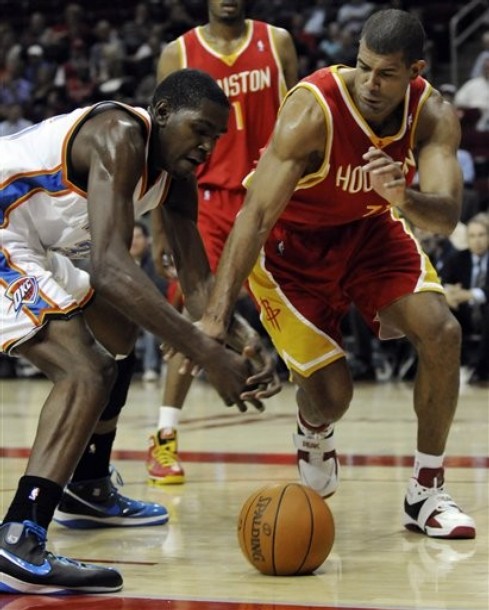
Thunder Rockets Basketball SLAM: It seems like Michael Lewis’ New York Times article on Shane Battier has been the link to making casual NBA observers and those traditionally opposed to quantitative analysis become a little more comfortable with it.

DO: It’s funny how much that one does get brought up. I’m always a little bit surprised. But Michael Lewis is a very good writer, and I enjoy his stuff. I had lunch with him I think it was either Fall of 2004 or spring of 2005, so about three years after his book Moneyball came out. Which was very helpful to us in basketball. I wrote my book, and it came out a few months after Moneyball so I got lucky there. His book got read by a number of people in NBA front offices and they were interested. I was able to, through a series of lucky circumstances, be able to walk around and hand my book to certain people and say ‘You read Moneyball, I can help you do that.’ When I had lunch with Michael Lewis, I said thank you. [Laughs]

SLAM: Basketball is ideal for quantitative analysis. The pace is there, there’s enough action going on.

DO: I certainly love it. It’s interesting. There are a lot of sports out there not getting near the attention of the numbers, but there’s a number of sports that haven’t gotten the attention of the media for how much the numbers have helped. My wife is from Brazil and the Brazilian women’s volleyball team uses numbers extensively. They are very, very good. I think there has been a little bit of media attention on soccer. There are some efforts in soccer from using analytics to make a difference. I do think about these other sports and try and put basketball in perspective.

With regard to those, what basketball has is a lot of elements from the other sports. Or looking at it the other way, there are elements in basketball that can be taken to help in some of those other sports, as well. There is a lot that happens in a game. You have a pretty long record of those things. That does help. Some of these other sports will pick up in the data collection process.

SLAM: I’m interested to know a couple overvalued and undervalued statistical measures you see.

DO: Oh boy, this question is always difficult because the market for these things is not clear to me. How much people are using unadjusted plus/minus…I think that’s actually a very interesting number, and I don’t hear people talk about it too much. It has certainly some flaws to it. It’s been around a long time. On the surface of it, I would say that’s under-appreciated right now. The NBA is putting it in its box scores now. I think last year was the first full year I saw it.

SLAM: With plus/minus, it’s difficult for people to accept that sometimes. Wasn’t Kevin Durant considered before last season someone who cost his team too much value in that category?

DO: There was simple analysis done on Durant that came out that way. I remember that. I remember thinking that I went to grad school, and I used statistics. There are certain pieces of data that come out that they look correct, but the answer is just wrong. There’s this temptation now to do it every time a result is weird. If you do the analysis right, there will be a handful of cases where it’s just wrong. And I think anybody who has seen Kevin Durant, anybody who has done other types of analysis on Durant, would have said that doesn’t make sense. Getting back to the media, you guys are a mouthpiece for a lot. I’ve been asked about [that Durant analysis] a few times, and i think about how it’s not anybody’s fault that it got out there and got all that news. Because it’s so weird, you have to say ‘wait a minute.’ Somebody did the analysis, and it gets blown up because it’s so weird.

SLAM: Well, it’s like in baseball where a lot of sabermetricians say RBIs don’t matter. It’s hard for people to accept that because it’s been such a fundamental statistic.

DO: Yeah, well I think the conversation about what works and what doesn’t work gets a little bit noisy. If you get people to actually discuss without taking a right or wrong position…historically a lot of people have said, ‘Well, yeah he got an RBI because that guy set it up for him, he moved the runner over.’ So you’ve heard that for a very long time. Perhaps the voices now are more definitive and more broad. Now, the voices are saying a lot of things. A lot of RBIs aren’t that valuable, or overvalued. People have been saying a lot of these things, just not as broadly or strongly.

SLAM: Are there any overvalued/undervalued measure you can point out.

DO: Overvalued, I’m not sure.

SLAM: I mean, assists, right? Assists aren’t representative of a player’s passing ability.

DO: Well, yeah, that’s a better way to phrase it, actually. Whether it’s overvalued or not, it’s not necessarily a reflection of a player’s passing ability. It’s certainly a reflection of how much they have the ball. There’s a subtle difference in the language, of course, in whether it’s overvalued. It can be easily misinterpreted.

  • Add a Comment
  • Share
  • RSS

Tags: , , , ,

  • http://slamonline.com Bryan Crawford

    Nice job, Kyle. But for a guy like myself who feels that the game is played on the court and not with a calculator, I’m till not convinced of the value of analytics. Especially not when Mr. Oliver stated that half the teams in the NBA “dabble” in it and 7-10 teams use it in their decision making process. That’s just more supporting evidence for me that despite what “stat guys” would have you believe, advanced stats are just not that popular. Sure, you have a community of people that support analytics, but they represent such a small percentage to the point that they’re insignificant in the grand scheme although they’re certainly loud and boisterous enough to have you think that they represent a large majority.

  • http://PSD Chronz

    Well Bryan, would it change your mind if the half that did “dabble” were among the most successful franchises? Now it doesnt take a genius to realize building around a player like Kobe can lead to a competitive squad, the true value in statistics lay in building the core around that special player or in building a team sans superstar. Take Daryl Morey for example;

    The Houston Rockets were able to field a competitive team despite being crippled by the absence of 2 MAX players, think about that, thats like the Lakers losing Kobe and Pau and still going .500. The Rockets were able to accomplish something no other team has ever done due to the fact that they were continuously able to find diamonds in the rough in the draft and free agency in large part because of their statistical markers.
    Now this can be accomplished without the use of stats but the fact of the matter is this, if we were to replace all the decisions made in the draft as a result of “intuition” with the selections a computer model projects as the superior prospect, chances are your team will be better off.

    I dont know what gives you the impression that stat geeks are “loud” or that they represent a majority movement when the article you just read contradicts that very statement.
    I understand Dean O doesnt represent every stat head out there but in my experience we are well aware of where we stand among the masses. All you have to do is visit truehoop to see how often they refer to themselves as outsiders or geeks. Still the movement is happening, you can either get with the program and optimize your decision making process with tons of useful information, or you could be like the Clippers and be left behind.

  • shu

    Did you ask how his fantasy basketball team did last year? Who’s his “sleeper pick”?

  • Nathan

    The interviewer worked but I don’t think Oliver really gave him that much back with any depth or precision. Has he even opened the door for any interns? If not, that would be disappointing.

  • http://PSD Chronz

    PS The Kobe mentioning was in no way related to the Lakers being among those teams, they are actually one of those teams that totally disregards stats from what Ive heard

  • permaculture james

    I like the section on possession based analysis (p3). Overall though, at times he seems almost evasive — not a slam really, maybe just the nature of being a quantitative guy — or maybe coy and protecting his data? Would love to watch a game with him and learn more. Hard to quantify how much the stats reveal the game or conversely, whether the true nature of the game gets obscured by the chess match of coaches in real time. For example, does someone like Phil Jackson has an ace up his sleeve that will appear during the playoffs in something as small as resting a guard a few minutes earlier in the game yet keeping total minutes the same.

  • permaculture james

    i meant p4

  • Jerome

    Playing and coaching Cal Tech was probably about the same level as a run of the mill high school team.

  • Jerome

    To get inside the league you got to be pretty good but also got to know how to pimp it. Pimp it to the right guys for the sale. The best pimps win.

  • http://slamonline.com Bryan Crawford

    @Chronz: If by “successful” you mean that half of the teams that “dabble” in analytics in some form or fashion finishes a season .500 or better, does that really equate success? No matter how you slice it, the end game in professional sports is a championship. Fans (people who buy tickets) are only going to accept the notion of, “Our team had a great season” for so long. As of a year ago, only 9 teams have an analytics department: Boston, Cleveland, Dallas, Denver, Houston, New Jersey, Oklahoma City, Portland, and San Antonio. Of those 9, only Boston and San Antonio have won championships and it can be argued that in the case of the Celtics, analytics had almost nothing to do with it. As for the Cavs, they had LeBron James. The real test (and value) of their analytics department will come this season. Will they be like Morey’s Rockets and not have their ship sink totally with their marquee and franchise guy gone? That remains to be seen. And what about the Nets? Analytics didn’t help them. They won 12 games last season. OKC’s analytics department seems to be doing a great job in constructing their team, but even with a great player like Kevin Durant, can they really win a title? And the rest of the other teams are really just middle of the pack. They have great regular seasons, but are no real threat to win a title. Not even the Spurs anymore. I just think that analytics in basketball makes mediocrity acceptable and teams that integrate it into their decision making process will be just that and the teams that rely more on traditional talent evaluation of players and assess value that way will continue to outshine them. The notion that a computer model can build a better team than good, old-fashioned basketball “intuition” is silly, IMO and I ask you, are these computer modeled teams being built to win something tangible — like an NBA Championship trophy — or just a good amount of regular season games?

  • Preston

    Most of the stat geeks were hired by already good teams. So you’ve got selection bias.

  • Tom

    I agree with you to a certain extent Bryan. I think the real value in quantitative analysis in hoops is not so much in determining who’s good and who’s not. But in determining which groups play well together, and which players would play well in a certain system. For example there are some players in the league that can only be successful in an uptempo system and if you put this in a half court system they would be far less effective. And to an extent you see that with OKC, and houston. All the players on those squads really fit the systems being used there

  • Tom

    PS…..great interview.

  • http://slamonline.com Bryan Crawford

    @Tom: Sometimes, it’s not always about the best fit that gets it done. Even though they won, was Ron Artest really a better “fit” in LA than Trevor Ariza? Sure, it works now, but are the guys surrounding Kevin Durant really championship caliber pieces? Sometimes, you have to go away from what the numbers say that works and put a squad together that you know is going to be capable of winning it all when the time comes. That’s all I’m saying. Sure, certain systems fit certain players better, but if you’re always looking for the “right fit,” your team is not going to be very good. Sometimes, you have to be unconventional if you want to compete for something other than just regular season victories and whether it suits a player or not, these guys are pros. They’ll adjust.

  • DW

    There are lots of analytic ways you can learn about “fit” and apply that knowledge. Including playoffs and clutch.

    Boston has analytic help.

    Lakers, there were rumors Rudy T’s son did some computer work for them. Not sure how much analysis.

    But their system guys for offense and defense, I’d call them analytic, general speaking, but traditional tactical analysts. Focused on plays and getting stats out of them rather than analyzing the game in bigger bites. That form of analytic certainly pays off. Other kinds can too.

  • Ronald

    @Chronz: I hate it how the writer of Truehoop calls himself a geek despite not having the remote qualifications or brainpower to be considered one. He just uses the word to indirectly call himself “smart”. At least, the one use of quantitative analysis is to prevent GM’s from handing out bloated contracts largely based on scoring alone.

  • http://PSD Chronz

    —– If by “successful” you mean that half of the teams that “dabble” in analytics in some form or fashion finishes a season .500 or better, does that really equate success?
    Yes, like I said from the start. It doesnt take a genius or any sort of intuition to know building around Kobe will lead to success. But to try and say there is only 1 successful franchise per year is nonsensical IMO. Only 1 franchise obtains the ultimate level of success sure, but there are various levels of success. I guess this comes down to how you want to evaluate success.

    —– Fans (people who buy tickets) are only going to accept the notion of, “Our team had a great season” for so long.

    Based on? People buy tickets for a variety of reasons, just look at the Clippers. Theyve been turning a profit for decades and it has nothing to do with their success so a blanket statement like this is meaningless.

    —– it can be argued that in the case of the Celtics, analytics had almost nothing to do with it.
    Not really, Rondo was a stud by draft measurements

    —– As for the Cavs, they had LeBron James. The real test (and value) of their analytics department will come this season. Will they be like Morey’s Rockets and not have their ship sink totally with their marquee and franchise guy gone? That remains to be seen. And what about the Nets? Analytics didn’t help them. They won 12 games last season.
    So let me get this straight, you can credit the success to players but all the blame gos on stats for them losing? Thats pretty poor system man. I based success on whats expected of the team and what they control. For example, if a team drafts a solid prospect late in the draft due to analytics then its made a successful decision ala Ty Lawson. I dont look at raw W-Ls because there are alot of factors that go into that.

    —– OKC’s analytics department seems to be doing a great job in constructing their team, but even with a great player like Kevin Durant, can they really win a title?
    I dont know, nor do I care. All I know is that awhile back they were nowhere near where they are now. Thats a SUCCESSFUL TURNAROUND. One that actually only happened because Portland actually went against what the stats and models said to do and went with conventional wisdom of taking big over small when every metric out there said to take Durant.

    —— And the rest of the other teams are really just middle of the pack. They have great regular seasons, but are no real threat to win a title. Not even the Spurs anymore. I just think that analytics in basketball makes mediocrity acceptable and teams that integrate it into their decision making process will be just that and the teams that rely more on traditional talent evaluation of players and assess value that way will continue to outshine them.
    I dont see a shred of proof to promote this opinion but ok

    —– The notion that a computer model can build a better team than good, old-fashioned basketball “intuition” is silly, IMO and I ask you, are these computer modeled teams being built to win something tangible — like an NBA Championship trophy — or just a good amount of regular season games?
    They are meant to be an upgrade, whether you win a title or not is dependent on so many external factors that trying to pin them down to a single aspect is laughable, that you find it silly is again irrelevant when you look at the historical results of draft rating models this decade, it is a quantifiable fact that they have done a better job of landing impact talent.

  • http://PSD Chronz

    WOW that totally didnt work out the way I envisioned, Ill just copy my retorts to your claims

    On Success:
    Yes, like I said from the start. It doesnt take a genius or any sort of intuition to know building around Kobe will lead to success. But to try and say there is only 1 successful franchise per year is nonsensical IMO. Only 1 franchise obtains the ultimate level of success sure, but there are various levels of success. I guess this comes down to how you want to evaluate success

    On Consumer Tendencies
    Based on? People buy tickets for a variety of reasons, just look at the Clippers. Theyve been turning a profit for decades and it has nothing to do with their success so a blanket statement like this is meaningless.

    On the C’s title
    Not really, Rondo was a stud by draft measurements and Perks signing screams moneyball tactics

    On your system for evaluating success
    So let me get this straight, you can credit the success to players but all the blame gos on stats for them losing? Thats pretty poor system man. I based success on whats expected of the team and what they control. For example, if a team drafts a solid prospect late in the draft due to analytics then its made a successful decision ala Ty Lawson. I dont look at raw W-Ls because there are alot of factors that go into that

    On OKC Building Plan
    I dont know, nor do I care. All I know is that awhile back they were nowhere near where they are now. Thats a SUCCESSFUL TURNAROUND. One that actually only happened because Portland actually went against what the stats and models said to do and went with conventional wisdom of taking big over small when every metric out there said to take Durant

    On Draft Models being better indicators of talent vs intuition
    They are meant to be an upgrade, whether you win a title or not is dependent on so many external factors that trying to pin them down to a single aspect is laughable, that you find it silly is again irrelevant when you look at the historical results of draft rating models this decade, it is a quantifiable fact that they have done a better job of landing impact talent.

  • http://PSD Chronz

    To Bryan again
    @Tom: Sometimes, it’s not always about the best fit that gets it done. Even though they won, was Ron Artest really a better “fit” in LA than Trevor Ariza? Sure, it works now, but are the guys surrounding Kevin Durant really championship caliber pieces? Sometimes, you have to go away from what the numbers say that works and put a squad together that you know is going to be capable of winning it all when the time comes. That’s all I’m saying. Sure, certain systems fit certain players better, but if you’re always looking for the “right fit,” your team is not going to be very good. Sometimes, you have to be unconventional if you want to compete for something other than just regular season victories and whether it suits a player or not, these guys are pros. They’ll adjust.

    Analytics are what help you decide whats the best fit, intuition isnt going to tell you how often playerA made a shot from zone B when open. Because you are incapable of watching every possession from every player, going by gut instinct instead of factual data is counter productive. Your eyes can lie just as much as the data. So there is no SINGLE WAY of building a team, simply put if you ignore the stats it will eventually catch up to you

  • http://PSD Chronz

    @Chronz: I hate it how the writer of Truehoop calls himself a geek despite not having the remote qualifications or brainpower to be considered one. He just uses the word to indirectly call himself “smart”. At least, the one use of quantitative analysis is to prevent GM’s from handing out bloated contracts largely based on scoring alone.

    This may be true but I consider myself a statgeek and at the risk of tooting my own horn and coming off just as egotistical, I hold a certain amount of respect in the blogoshphere/forums because of this openness to statistics, yet compared to the likes Dean, Kevin and Hollinger, Im a nobody.

    I dont think you should hate someone taking pride in their work, atleast when they admit their flaws, which Ive seen Henry do.

Advertisement