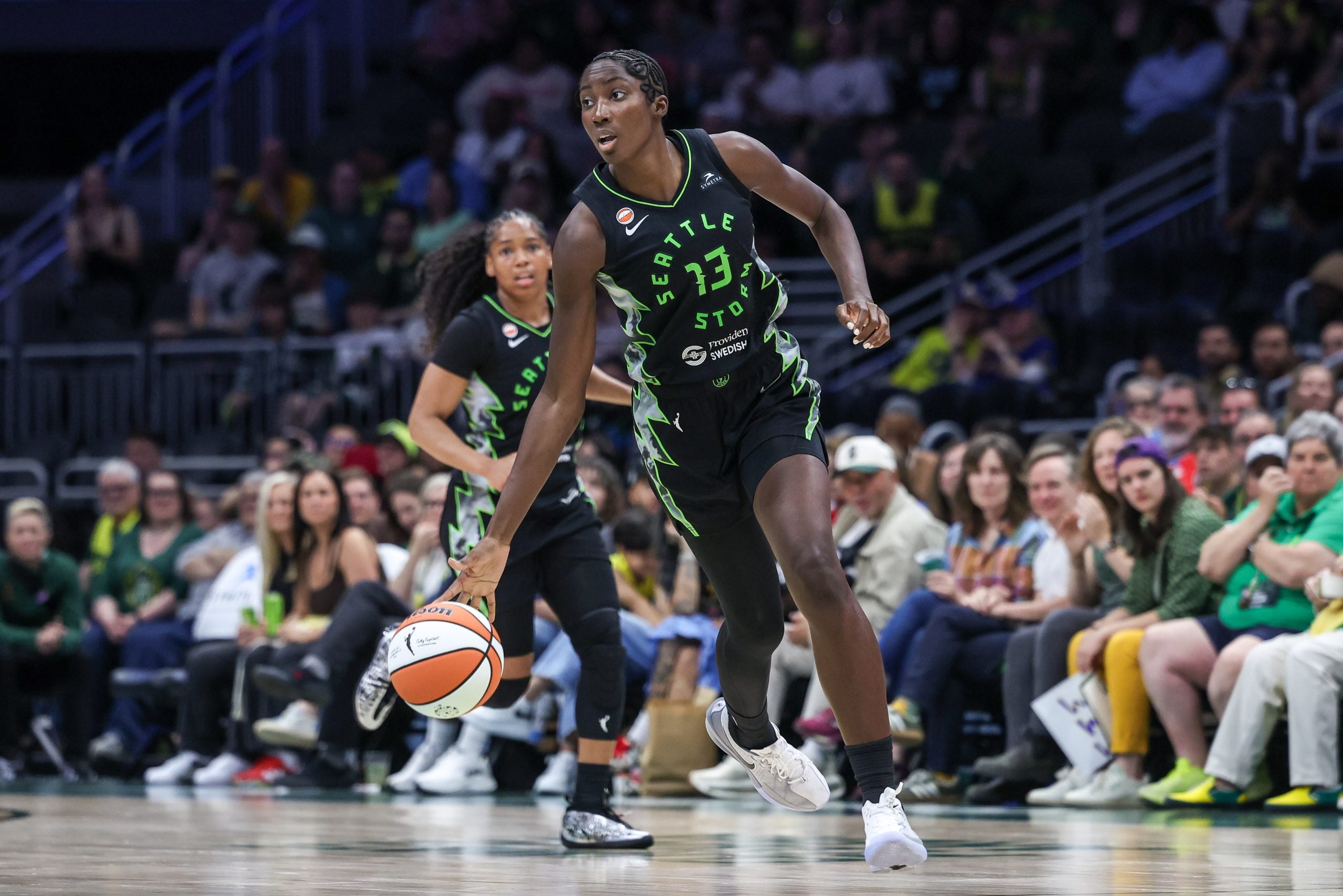
Original Old School: Unhappy Gilmore
Artis Gilmore finished with over 20,000 points and 15,000 rebounds in his career but has yet to be enshrined in Springfield, even 22 years after his final NBA game. In SLAM 15, one of basketball’s greatest big men talked about his career and that wait for the Hall of Fame. — Ed.
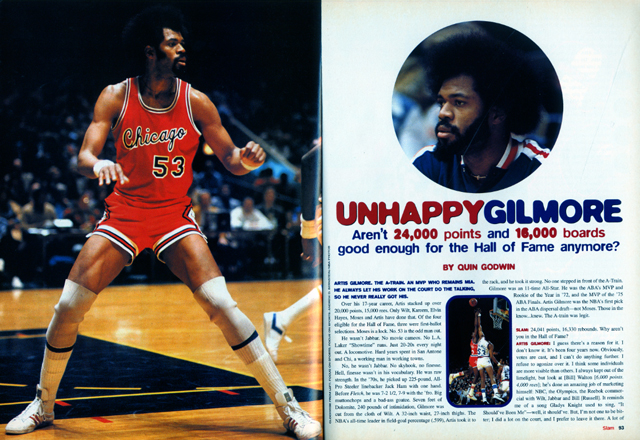
by Quin Godwin
Artis Gilmore. The A-Train. An MVP who remains MIA. He always let his work on the court do the talking, so he never really got his.
Over his 17-year career, Artis stacked up over 20,000 points, 15,000 rees. Only Wilt, Kareem, Elvin Hayes, Moses and Artis have done that. Of the four eligible for the Hall of Fame, three were first-ballot selections. Moses is a lock. No. 53 is the odd man out.
He wasn’t Jabbar. No movie cameos. No L.A. Laker “Showtime” runs. Just 20-20s every night out. A locomotive. Hard years spent in San Antone and Chi, a working man in working towns.
No, he wasn’t Jabbar. No skyhook, no finesse. Hell, finesse wasm’t in his vocabulary. He was raw strength. In the ’70s, he picked up 225-pound, All-Pro Steeler linebacker Jack Ham with one hand. Before Fletch, he was 7-2 ½, 7-9 with the ‘fro. Big muttonchops and a bad-ass goatee. Seven feet of Dolomite, 240 pounds of intimidation, Gilmore was cut from the cloth of Wilt. A 32-inch waist, 27-inch things. The NBA’s all-time leader in field-goal percentage (.599), Artis took it to the rack, and he took it strong. No one stepped in front of the A-Train. Gilmore was an 11-time All-Star. He was the ABA’s MVP and Rookie of the Year in ’72, and the MVP of the ’75 ABA Finals. Artis Gilmore was the NBA’s first pick in the ABA dispersal draft – not Moses. Those in the know…knew. The A-Train was legit.
SLAM: 24,041 points, 16,330 rebounds. Why aren’t you in the Hall of Fame?
ARTIS GILMORE: I guess there’s a reason for it. I don’t know it. It’s been four years now. Obviously, votes are cast, and I can’t do anything further. I refuse to agonize over it. I think some individuals are more visible than others. I always kept out of the limelight, but look at [Bill] Walton [6,000 points. 4,000 rees]; he’s done an amazing job of marketing himself: NBC, the Olympics, the Reebok commercials with Wilt, Jabbar and Bill [Russell]. It reminds me of a song Gladys Knight used to sing, “It Should’ve Been Me” – well, it should’ve. But, I’m not one to be bitter; I did a lot on the court, and I prefer to leave it there. A lot of records I set, still have yet to be broken. At [Jacksonville U], I averaged 20-20 for my career and led us to the Final Four. I’d like to think I’d get in on merit alone.
SLAM: Rick Barry mentioned the taint of playing in the ABA. You, along with Dr. J, were the ABA. Do you think it’s had an affect on your image?
AG: Without a doubt. We [ABAers] were submerged by the NBA. In NBA cities, like Chicago and Detroit, the NBA had a vice grip on the press. They didn’t even run ABA box scores, except for in New York, due to the Nets. Now, if a guy in Yugoslavia wants to watch the CBA on TV, he can, via a satellite service. In the ’70s with just three networks, we were lucky to get any TV time at all. I think our first year, CBS came in and did three playoff games. Now, stations are itching for stuff.
It was like the ABA was a virus. No one wanted to get near us. Guys like me, James Silas and Dan [Issel] weren’t household names like a Jabbar or Wilt. Even after going to Chicago, I was referred to as Ernie Gilmore in a news story. Even NBA players themselves, I felt, held some resentment towards us. I think they thought of the ABA as double-A ball or something. It was a joke. There was no doubt, after the merger in ’76, as to our talent. And, in time, I think the NBA guys acknowledged it.
SLAM: Weren’t you even ID’d at a nightclub in Chicago?
AG: It wasn’t so much that I was ID’d. I think I showed them a few IDs, but they still wouldn’t let me and Mickey Johnson into the club. It was a racial situation. I don’t think they realized that I was Artis Gilmore of the Chicago Bulls – I was just a black guy. Mickey was taking me out on the town, showing me the city, and we just ended up on Rush Street. It was the night I had signed with the Bulls after the merger. I didn’t make a fuss about it, but somehow the press got wind of it. I was a sent a letter of apology by the club, but the milk was split. But no, I wasn’t even recognized in the city I’d just signed to play in.
SLAM: Do you think winning an NBA title would’ve earned your more respect?
AG: Yes. But basketball is a game of five, not one. I didn’t get Magic to play with in Chicago. I didn’t get Oscar, Silk, Worthy. It’s tough to win without a supporting cast. In ’75 in the ABA, when I did have it with Dan [Issel], I won. In Chicago, it was a joke.
To give you an idea of how it was – and this is not meant as a slap in the face – Mickey Johnson was a walk-on who stuck. Wilbur Holland we got off waivers; we gave him a shot because we were in dire straits with our guards. He stuck. And me and those two were our yearly offerings for the All-Star game. So it was a tough situation to win games. A title? I don’t think so.
SLAM: In ’76, at the ABA’s first and only slam dunk contest, David Thompson said you tried to rip the rim off. Did you?
AG: I didn’t know what I was doing. I was the first to dunk in the first dunk contest. So I went with what I knew best. Power. See, I had great leaping ability for a guy my size, and I got way up. By the time I went to dunk, my entire arm was down in the rim. I was just trying to get the fans into it. I also did a two-ball dunk, with a ball in each hand, and a reverse one-hand jam.
But, a dunk contest is a showcase for the 6-3, 6-4 guys. Seven-footers don’t belong in it. In ’86, at my last All-Star event, Spud Webb won it over Wilkins, and I still say ‘Nique won it. Crowds love the underdog, the short guy. I still think the craziest, most breathtaking dunker I’ve ever seen was a big guy: Larry Nance. He revolutionized my 2-ball dunk, doing it in a delay motion. It was a ballet with umphhh!
SLAM: How ’bout Dr. J? You came into the ABA together in ’71 and the NBA together in ’76. Was there anyone like him?
AG: Are you kidding? Julius was Mr. Entertainment. Mr. ABA. Mr. NBA. No doubt. If he was lacing ’em up, there was going to be a show. He was worth any price of admission. Any dunk? Ouch!
See, most guys come in straight with a dunk. So, as a center, I could gauge it. I was great at timing a dunk and blocking it. But Julius, he was able to move the basketball in mid-air, change directions and get to the basket – chest-to-chest with me – and dunk it. No one else did it. Julius, he did it a lot.
The thing with him was that, if he did dunk it, fans went psycho. Sixers fans. Our fans. Kids. Old ladies. Why not? He was the Doctor. It got so ridiculous that [Colonels coach] Hubie Brown had a $50-Dr. J rule. If Julius was fast-breaking in the open court, we were to lay a foul. Don’t hurt him, just don’t let him dunk, or its $50. In the ’70s, in Louisville, it was an awful lot of money.
SLAM: Was blocking shots your signature?
AG: It was like this – guys thought they could bring the ball in and score, and I thought that I could stop them. I felt a great sense of confidence in the paint on defense; it was my comfort zone. I took a great deal of pride in swatting a guy’s shot out of the sky. I felt I could block anything.
Anything, that is, except Jabbar’s skyhook. With Jabbar it was a different set of rules. He’d get the ball in rhythm, go to the skyhook, and it was money. So the one thing that I felt I did really well was distort his rhythm and not let him get into it. I’d frustrate him. But block the skyhook? I never did, in 12 years in the NBA. I wasn’t alone.
SLAM: Do you remember anyone ever blocking a shot of yours?
AG: There weren’t many. But the sole time I went to war against Wilt in an ABA-NBA All-Star game, he did it. Hubie told me, “Artis, he’s going to go for it. Wilt loves blocks. I thought, yeah, yeah. Then, whack! He got it. I thought I did a good job of getting up off the floor, but he got it.
SLAM: What was Maurice Lucas [6-9, 215] thinking when he got into it with you?
AG: I was getting sick of his bodying me in the paint, and I got hot. I took a swing at him, missed, and then continued after him, chasing him on the floor and eventually backing him into a corner on the court. The next thing I knew, I was coming to after being KO’ed. I don’t know if I ran into a right or a left, but it sent me to my knees. I was out for a while. I heard that he closed his eyes and took a wild swing at my chin. Well, it was on target. I don’t think too many guys messed with Maurice after that.
SLAM: Was Jabbar the greatest big man you ever played against?
AG: It’s weird. Emotion plays a big part in basketball, so, on any given night, there were guys who would just play tough – Bill Walton, Bob Lanier, Dave Cowens. But on a night-in, night-out basis, Jabbar was the greatest. The skyhook. If it was all he’d had to go to, it’d have been enough. Unfortunately, it wasn’t. Jabbar, in the blocks, was like a torture chamber.
Cowens was tough too. You knew you were going to be in a dogfight with him. He was a good perimeter shooter, so it forced the opposing center to come out. Then, once you came out, he just juked by you and took it to the basket. It made it a 48-minute grind. He had an 18-foot jumpshot, and if you let him take it, he’d kill you with it. He worked at it to really make it a part of his game.
SLAM: As a kid from Chipley, FL, did you ever imagine you’d play 17 years in the pros and sign a $4.5 million dollar contract?
AG: Not in my wildest dreams. My main objective was to graduate from school, which I did, and be an example to my younger brothers and sisters. Later, as I was setting records at JU, I began to think, “Hey, I got a shot at the pros,” but the league didn’t have as many teams back then and the pressure wasn’t as great as it is now. So, no, it wasn’t a pervading thought of mine.
As a kid, when my feet grew beyond size 13, the last size the stores carried, I had to go barefoot. To earn money, I’d pick watermelons for $5 a day, so $4.5 million wasn’t even within my realm of thinking. This is why I’m not bitter over the lack of recognition of the Hall of Fame, because God’s blessed me so much already.
SLAM: About those Nike TV commercials with Chris Webber that were shot in the barber shop in San Antonio. How did Ice [George Gervin] get all those lines, and you not get any?
AG: Neither one of us were written into the script. Ice just had a way of drawing the spotlight to him. That’s just Ice.