From ’96 ‘Til Infinity…
This piece is an exclusive that originally ran in BUCKETS: Issue Two. Go to bucketsmag.bigcartel.com to visit the online store.— Ed.

by Brad Graham
The 1995 crop of conscripts, captained by mighty mouse Damon Stoudamire—which also included top choice Joe Smith; Antonio McDyess; UNC duo Jerry Stackhouse and Rasheed Wallace; draft gem Michael Finley and the infrequently spectacular but still raw and uncut, Kevin Garnett—was an armada of serviceable war vessels, but their collective artillery, as mighty as it would prove to soon be, never quite conquered like the new-age fighter jets that were about to take off during the following summer.
June of ‘96 was more than Michael Jordan’s triumphant return to the champagne shower, following his record-setting 72 regular-season victories. It was also a platform for the NBA’s 50th recruitment drive wherein the Philadelphia 76ers, holders of the No. 1 pick, attempted to correct their horrid 18-64 campaign.
Echoes from Jordan’s now perfect return served as fitting background noise to a night which ushered in both the signifier of his mortality—the Sixers’ new dynamic, lightening quick, barely 6-foot prize, Allen Iverson—and true heir to his vast fortune—Lower Merion ace, Kobe Bryant. Of course it’s unfair to only credit those two when the ‘96 Draft is widely viewed as a game-changing tsunami but it’s also impossible to supplant The Answer and Black Mamba as towers along the NBA’s growing skyline.
Conveyor of the stance that ‘size is highly overrated,’ Iverson did more than simply cross-up his Airness during that transformative ‘97 season, he also and instantly brought about discussions of age, establishment and evolution but none of it could’ve been possible had the Sixers not dropped their confident young gunner straight into the war zone (where he was forced to learn on the job in a backcourt operation that was kamikaze). Contrastingly, Bryant’s early interactions with Jordan and the NBA brought about a much quieter discourse with far less fan applause before taking on a vastly different, almost perverse line of conversation.
As previously mentioned, the early rumblings of the ‘96 Ronin weren’t limited to the brashness of Iverson or the preciousness of Bryant. Elsewhere, because NBA law states that an expansion franchise can not land the top lottery pick during its first three seasons, the Vancouver Grizzlies, owners of a league worst 15-67 record, went from favorite for No. 2 to having to settle for bronze (as they were leap frogged by fellow Canadian bacon, the Toronto Raptors—who ended their own first term with an equally embarrassing standing of 21-61).
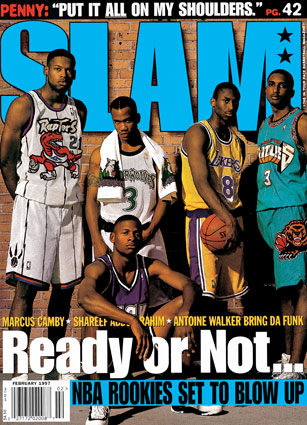
While Iverson hogged the national spotlight, as the fish who could save Philly, the Raps nabbed NCAA Player of the Year, Marcus Camby—to complement Stoudamire—before the Grizz opted to secure the services of one-and-done phenom, Shareef Abdur-Rahim (in an attempt to make us all forget about instant flameout, Bryant ‘Big Country’ Reeves).
On draft night, the 25-57 Milwaukee Bucks were forced to select fourth after their 20 percent chance of landing pole position in the lottery failed. Calling out Stephon Marbury’s name, they promptly exchanged his rights with the team going fifth, the Minnesota Timberwolves, who grabbed UConn darling, Ray Allen. Now Minny had a shiny new ball-handler to fuse with its frontcourt sensation, teenager Kevin Garnett—a promising modernism, who skipped the mandatory retail sector, advancing directly from warehouse pallet to consumer cupboard for the first time in decades.
Foolishly giving up their first round picks in both ‘96 and ‘97 (to the Boston Celtics) for cumbersome center Eric Montross (the C’s first rounder in ‘94), the Dallas Mavericks should’ve enjoyed the sixth selection but instead had to watch their pick default to Beantown. Boston quickly acquired Antoine Walker and sent the Mavs a bottle of vintage red. From there, another six players, mostly unavailing, faulty clunkers, as it  would later appear, where all drafted before the 41-41 Charlotte Hornets were put on the clock.
When Kobe Bryant’s name was announced by Commissioner David Stern, it was a watershed moment that changed perceptions forever. All of a sudden it was skill, not size, deciding if teenagers could stand shoulder-to-shoulder with grown men. In a move orchestrated by league logo Jerry West, the Lakers sent established Euro center Vlade Divac thousands of miles across the US for the rights to Bryant. With Shaquille O’Neal also arriving in Hollywood that same summer, courtesy of free agency, the fate of a dozen franchises changed trajectory as the weight of power shifted from East Coast to Wild West.
On the flip side to that same high school coin, the Portland Trail Blazers’ choice, Jermaine O’Neal (taken 17th) had seemingly found himself with little-to-no choice but to throw his name into the draft hat (because his senior grades stunk). What made Kobe’s defiance (of the standard NCAA procedure) so startling was the fact that his test scores were exceptional. Unlike the highly publicized journey of Garnett one year earlier, who opted against attending JuCo, Bryant excelled in the classroom and could’ve collected his college degree at any number of the nation’s blue-ribbon campuses and yet, given every possible option, he chose to do what no one dared, what no one thought possible—he declared, as a shooting guard, for the NBA. The notion that a loud, cocky, trigger happy, attention seeking teenager could seamlessly progress from schoolyard bully to boardroom businessman, on his own terms, was laughable, at least at the time. What KG trashed in ‘95, and what the two ‘96 teens exploited that following summer, was the idea that apprenticeships couldn’t succeed in the NBA workplace. Thanks to these oversighted gambles, isolated cases quickly opened the gateway for basketball’s decision makers to trial, and eventually implement, a rogue custom as vogue.
At season’s end, without the same first-year restrictions as his brethren, and with his brash, individual dexterity towing instant cult-status, Iverson was made numero uno in Rookie of the Year voting, even though his team chalked up a cheerless 22-60 record. He was followed in the final tally by Stephon Marbury, who posted impressive averages of 15.8 points and 7.8 dimes; while Abdur-Rahim, third, joined them on the podium (despite the Grizzlies’ league-worst 14 victories).
Expected to be an instant franchise savior—after setting the ‘95-96 NCAA season ablaze as a member of Rick Pitino’s University of Kentucky Wildcats; a squad which has since been widely viewed as on par with the ‘91 UNLV Runnin’ Rebels because of their depth and dominance in the Tournament—Antoine Walker, could only lead his hapless Celtics to 15 wins, a new low-point in Shamrock history. Despite the deplorable team ranking, Walker did enough to impress the Association’s coaches, who collectively decided he should join Iverson, Starbury and Abdur-Rahim on the All-Rookie First-Team. Rounding out the first year’s top starting unit was Camby, who tallied 14.8 points (his career high), 2.1 swats and 6.3 boards per game for the teething dinosaurs.