Which MJ was the Greatest?
by Vincent Thomas / @vincecathomas
My first vivid sports memory involved the Lakers and they have remained my favorite team, in any sport, for the last 25 years of my life. The Showtime Lakers were my squad, so Magic was my dude. I have never rooted for an athlete with as much passion as I rooted for Magic. It was that young-kid, “nothing else matters,” berserk kinda passion. This makes me a bit biased when it comes to anything that has to do with Magic. But, as you grow up, hopefully you get more rational about hoops and this should especially be the case as a journalist covering basketball. What I’ve always thought was irrational, though, is how people (especially my generation) think there is not a valid argument for any player, other than Michael Jordan, as the “greatest of all-time.” Four men are in that discussion — MJ, Magic, Kareem Abdul-Jabbar and Bill Russell. In SLAM’s March issue (the one with Brandon Jennings on the cover) I posited my rational, somewhat objective case for one of them. Here it is…
***
Magic Johnson is the greatest basketball player of all time. Wait! Before you scoff and flip to another story—or, even worse, cancel your SLAM subscription—based on an assertion that, I’m sure, some of you view as patently absurd, give me a second to explain.
Michael Jordan is, undeniably, the best basketball player to ever put on a pair of shorts and play organized basketball. No arguments here on that one, OK? But there is a difference between T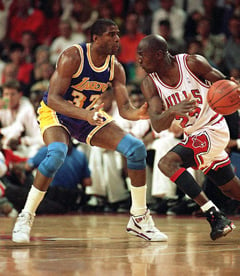 he Best and The Greatest. Did anyone ever play the game at higher and simultaneously more accomplished levels (better) than Jordan? No. Has there ever been a player who had a broader and more active impact on the game’s progression on and off the court (greater) than Jordan? To most of you, definitely not.
But screw you, I think Magic Johnson is the greatest athlete to play organized basketball. His impact, influence and excellence are more varied, broad and dynamic than all of the other greats, Jordan included. At the very least, his career presents an interesting argument.
Let that marinate for a while. We’ll get back to it. But before we do, we need to rewind.
It sounds weird anytime you hear Magic called “Earvin,” doesn’t it? Even though “Magic” is his nickname, it feels like we should put his birth name in quotes, like “Earvin” Magic Johnson. This stems from Fred Stabley Jr, a sportswriter for the Lansing State Journal. As a 15-year-old martian, on his way to leading Everett High School to the first of back-to-back state titles, Magic dropped a 36-16-15 gem that hypnotized Stabley into calling him “Magic.” Years later, during his rookie season in the NBA, Magic was describing what it was like when he got out on the break with the Lakers. When we’re rolling and the break is going,” he said. “I guess it looks like I am performing magic out there.” You ain’t lyin’.
Everything that took place in Magic’s formative life crested in the 1979 NCAA Championship game, when Magic led the Michigan State Spartans to the title game against Larry Bird and his mid-major Indiana State Sycamores. The Spartans won in front of a record-setting television audience. The hype and build-up for that game and the subsequent buzz set the foundation for the Final Four that we know now, the second biggest sporting event in the country after the NFL’s Super Bowl. As Seth Davis’ recent book so aptly coined it, that game was “When March Went Mad.”
Los Angeles was next to go mad. Magic took L.A. by storm. He was perfect for a city like Los Angeles that is defined by Hollywood, which values celebrity above all else.
“When he arrived in L.A., that’s when everything changed,” recalls Pat Riley, the guy who coached Magic to four of his five championships with the Lakers. “He was the flash point. He was a transformative figure in L.A. and remains one to this day. Back then…I mean, the Lakers organization had great players before—Wilt [Chamberlain], Jerry [West], Elgin [Baylor], Kareem [Abdul-Jabbar], but Magic transcended everybody. You could feel it. He was like the Pied Piper. He brought this incredible charisma and unorthodox talent. He changed the NBA and he changed basketball in L.A.”
The current L.A. is an unabashed Lakers town, the only city with multiple pro sports teams where basketball reigns supreme; it’d be this way if they had an NFL team, too. But it wasn’t always like this. Kareem’s Lakers were a boring, early round-exiting snore-fest that a town caffeinated on celebrity wasn’t enthused about. Magic changed that for good. At Magic’s peak, he was probably the celeb of all celebs in a city and state full of celebs. (As Richard Hoffer put it in his 1990 Sports Illustrated profile: “This town is comically blasé about celebrity. There’s just too much of it for people to take it seriously…But, here comes Magic, and Le Dome’s patrons, all true Angelenos, glance up and see six feet nine inches of maximun celebrity ambling their way. There is a time to be blasé (almost always) and a time to be slack-jawed (now!). They give him a standing ovation.”) In fact, after Magic turned the Lakers into “Showtime”—and he took his kilowatt smile and no-look passes to all the Western Conference cities two and three times a year—he altered basketball’s popularity West of the Mississippi, in general. The reason why you always see annoying purple and gold fans cheering the Lakers in their opponent’s arena is because, back in the ‘80s, Magic-induced Laker mania spread across the country. Even if Portland and Seattle already had die-hard fans, Showtime brought in casual fans who morphed into die-hard fans.
Magic’s first, and truly signature pro performance (and maybe the signature performance of his whole career) was the final game of his rookie season, with the Lakers, up 3-2, staring down the Philadelphia 76ers for the 1980 NBA title. One problem. Magic and his Lakers were at the Spectrum in Philly, but Kareem was back in L.A., nursing a gimpy left ankle. The thinking was that the Captain-less Lakers would give it a valiant go in Game 6, inevitably lose and hope that Kareem would be ready for Game 7. Except, we all know what happened. The 20-year-old Magic jumped center against the 7-1 Caldwell Jones and outclassed the Sixers for the rest of the game as the Lakers won their rings.
Kareem summed it up well: “It reminded me of the kind of game Oscar Robertson used to play in college…when he used to do it all. Just one man playing against boys. Except that Earvin was just one boy playing against men.”
His 42-point, 15-rebound, 7-assist, 3-steal performance in that decisive game, as a rookie, playing five positions (Magic called it “C-F-G Rover”), was not only the greatest Playoff performance of all time, but the dawning of a new age in the NBA. To watch someone his size post up, drain jumpers, run the fast break, throw Houdini passes, block shots, bang with the big boys for boards and so thoroughly dominate practically every square inch of the court was modern basketball’s Big Bang. Chris Webber wouldn’t have dreamed of running a break, at his size, before Magic. There would have been no point-forward Scottie Pippen without Magic. Kevin Durant is 6-10 with shooting guard skills. There’s no Kevin Durant without Magic. Before the unimaginative minds of the Cleveland Cavaliers organization turned LeBron into a small forward, he was a new model do-everything-phenom who owed more to Magic Johnson than any other predecessor. And this revolution of pro basketball all started, in earnest, with this game, when Magic’s hyper-versatility was on grand display, dominating the decisive game of a championship series.
That ’80 championship was Magic’s fourth title (including his two state titles in high school and his NCAA Championship) in five years. This wasn’t lost on Paul Westhead, the Lakers coach at the time, who quipped, “Magic thinks every season goes like that—you play some games, win the title and get named MVP.”
What’s interesting about Magic’s pro career, though, is that it started out in “peak-and-valley” mode.
Magic injured his left knee early in his second season and came back about five weeks before the Playoffs were to begin. The Lakers kept rolling during his injury—with Kareem, Jamaal Wilkes and Norm Nixon, it wasn’t like L.A. was a team full of scrubs—but without the buzz. When Magic returned, the cameras started flashing again and it was a huge media story. However, the squad was a bickering mess and got bounced in the first round by Houston.
Aside from all of this, Magic was beginning to feud with Westhead about how the offense should be run. Magic was so used to having the ball in his hands and orchestrating everything that sharing those duties with Nixon (especially while running the fast break) killed him. After a heated exchange early in the ’81-82 season, Magic told reporters he wanted to be traded. Westhead was fired instead. Magic was now a “coach killer.” Magic, perhaps the most beloved of all the NBA greats at the time, was booed at arenas for weeks after this.
The silver lining is that the Lakers inserted Riley as coach. Soon, Magic and his teammates made up. That sounds weird, doesn’t it? I mean, this is Magic we’re talking about, a guy up there with Bill Russell as the greatest teammate ever. It took him two years to get there, but from ’82 on, you couldn’t find a better, more influential, more motivational, more inspiring, more caring teammate in the League. Because Kareem was such an introvert and Magic was such a people person, it didn’t take long for him to assume the reins and become (here comes another superlative) one of, if not the, greatest leader in NBA history.
Present-day Lakers general manager and former Magic teammate Mitch Kupchak says his favorite Magic Johnson story is a minor one, but it’s indicative of who Magic was as a teammate.
“On my second or third day in L.A.,” recalls Kupchak, “we were in Palm Springs and had just finished practice. So Magic comes up to me and says, Mitch, why don’t you drive back to L.A. with me? He probably just sensed that I was having a tough time and thought, Hey, I wanna spend some time with Mitch. He asked me how things were going, if there was anything he could do better. And I say, Well, Earvin, I don’t know when you’re going to pass me the ball because, well, you’re not looking at me. He told me, It may not look like I see you, but I see you. So, if you’re open, be ready. And from that point on, I didn’t have any problems.”
Kupchak says that story sticks with him because Magic instinctively sensed that his new teammate was having trouble and took initiative to seek him out and do everything he could to make things better. That’s the kind of guy Magic was. The Lakers won another title that season. Magic averaged 17 points, 11 boards, 9 assists and 3 steals in the Playoffs and won his second Finals MVP.
The 1984 Finals were the first of Magic’s three epic, League-popularity altering battles with Bird for all the chips. Even though Magic averaged 18 and 15 for the seven-game series, he said, “We made five mistakes that cost us the series and I contributed to three of them.” These were mega-costly, potentially career-plummeting bungles in L.A.’s Game 2, 4 and 7 losses: he dribbled the clock down at the end of Game 2 until L.A. couldn’t get a shot off; he threw a pass away at the end of regulation in Game 4 and then missed two crucial free throws; in the huge Game 7, Magic went 5-14 and had 7 turnovers, including getting stripped twice in the final 90 seconds. Imagine this happening to Kobe or LeBron? It was so bad that Kevin McHale took to calling him “Tragic” Johnson the next season.
From that point on, though, Magic’s career arc turned ascendant and transcendent.
He finished second (to Bird) for the ’85 MVP, then went and averaged 18-15-7 on the way to L.A.’s third title in six years. But this title was different — they beat Boston. Vindication. He capped a League MVP with a Finals MVP in ’87, which featured his iconic “junior-junior sky hook” over the outstretched arms of McHale and Robert Parish — AT Boston Garden. The Championship in ’88 made L.A. the first squad to repeat since the Russell/Auerbach Celtics of the ’60s. He was League MVP in ’87, ’89 and ’90. Making All-NBA first teams and starting in the annual All-Star Game was yearly stuff for the greatest and most decorated player of the ’80s. By the time he met Jordan in the 1991 Finals, the NBA had gone from a League that was too black and too coked-up to have their Finals aired on live TV to, at the time, America’s hottest league and a sport encroaching on soccer as the world’s favorite. Magic, as the game’s most popular star, was most responsible.
At the close of the ‘80s, SI featured Magic on a cover with Joe Montana and Wayne Gretzky as “Masters of the ‘80s.” The issue featured a Rick Reilly essay extolling the three gods. In it, Magic dropped this quote: “I don’t want to be a businessman, I want to be the best businessman.” So, while he was still playing, he went out and got Hollywood super-agent Michael Ovitz to help chart a path through what was new terrain for an athlete. “The architecture for the business career that we created,” Ovitz said at the time, “was to put him in a position where he would be doing a lot fewer endorsements but developing a closer relationship in a continuing business. Many athletes have multiple-endorsement deals, but that’s not what we were interested in.”
Magic wasn’t cool with just pitching products. Magic wanted to own stuff. What you have now is Magic Enterprises, which includes Magic’s partnerships with companies like Starbucks and Lowe’s. The man is worth over $700 million. Jordan is the greatest sports pitchman of them all, but it is Magic’s ownership/partnership paradigm that heavily influenced filthy-rich athletes like LeBron and Tiger to try and follow—and the lower-tier guys trying to hustle a few hundred Gs or a couple million into a fortune all indirectly travel this path that Magic forged, too.
Everything was going great for Magic before he had to abruptly retire in ’91 because he had tested positive for HIV. When Magic made his announcement in the fall of ’91, the world stopped. At the time, there was a frightened paranoia that surrounded HIV and AIDS; those who contracted the disease were treated like lepers. Even Magic was ostracized by his peers, some afraid to play against or with him, others questioning his sexuality. Plus, it was viewed as a death sentence. Over the subsequent years, Magic has helped lead a nation that treated the disease as taboo to a relative state of awareness. It wasn’t just watching him hug players before and after winning the MVP at the ’92 All-Star Game, or seeing him still thrive physically in the ’92 Barcelona Olympics, bringing Showtime to the Dream Team. It was watching him continue to live a healthy life.
I met Magic for the first time during the 2009 Finals. I was lucky enough to be in his VIP section at an Orlando lounge and he was gracious enough to engage me. After a brief conversation, I gave him a pound and a hug and not once did I think, “I’m embracing a man with HIV.” No one does. That is what I call social progress.
From the time that Magic played his first game with the Michigan State Spartans in ’77, through his final, post-comeback dribble with the Los Angeles Lakers in ’96, Magic was either solely or significantly responsible for a host of things: bringing the Final Four to the forefront of America’s collective sports conscious with his ’79 NCAA Finals game against Larry Bird’s Indiana State; making America’s largest state and second-largest metropolitan area a Lakers state/city and coaxing the NBA out of a sort of geographic niche through his virtuosity and celebrity; he, along with Bird, were the two major players for the first half of the NBA’s Golden Age; he inspired every future generation of players taller than 6-8 to be versatile ballplayers, which makes him the player most responsible for the modern game we see today; his bout with HIV and his subsequent activist work for AIDS/HIV makes him one of the most socially important celebrities on the American landscape of the past 30 years; he set a model for athletes as businessmen and not just pitchmen.
In my book, that makes him the “greatest” ballplayer ever. Maybe not the “best.” But the “greatest.”
Vincent Thomas is a columnist and feature writer for SLAM, a contributing commentator for ESPN and writes the weekly “From The Floor” column for NBA.com. You can email him your feedback at [email protected] or follow him on Twitter at @vincecathomas.