Rise & Grind: How Jerry Sloan Became An All-Time Great NBA Coach
Originally published in SLAM 158
Until the early ’80s, just one pro basketball game was televised nationally each week. The same with college contests. That seems impossible now, but it’s true: You had to wait until Saturday for the “Game of the Week,” and even then you only saw the marquee teams—UCLA or Notre Dame; the Celtics, Lakers or Knicks.
Unless, like me, you lived in Chicago.
WGN televised every Chicago Bulls game beginning in the late ’60s, although the Bulls were hardly a marquee team then. Young players in Chicago grew up seeing Earl “The Pearl” Monroe, Elvin Hayes, Lou Hudson, Bob McAdoo, Nate Thurmond, Wes Unseld, Billy Cunningham—whoever the Bulls played, and not just the glamour teams.
More important, this also meant that Chicago kids grew up watching Jerry Sloan play 80 games a year from ’66 to ’76. This exposure had a huge impact on the local basketball scene. Chicago kids had their understanding of how to play basketball tattooed on them—metaphorically, in those days—by Sloan and WGN.
Jerry Sloan was born in 1942, while World War II was still raging. He grew up in southern Illinois, an area near McLeansboro known as “Gobbler’s Knob.”
Sloan was raised on a farm, but it wasn’t like the farm that Chicago kids saw on school field trips to the Lincoln Park Zoo. This was subsistence farming, just enough to get by. One cow, a couple of chickens. And, of course, corn.
Jerry was the youngest of 10 Sloan children whose father was a no-nonsense guy. Or so he was told: The elder Sloan died when Jerry was 4.
Like many kids, urban and rural, Sloan was in search of a father figure, and he found what he needed on the basketball court—which his father would have considered a frivolous luxury. In fact, Sloan thinks that had his father been around, sports might not have even been an option.
In high school, he woke up at 4:30 each morning to do chores, then made it to the McLeansboro Foxes’ 7 a.m. basketball practice with Coach Gene Haile. Sloan also played football and ran track, but when he grew six inches one summer, basketball clearly held more of a future than the other sports—or farming. Nobody could have predicted that the future meant 45 years in the NBA as a player and coach.
As a high school senior, Sloan accepted a basketball scholarship from the University of Illinois. But things didn’t go smoothly.
“I’d never even been out of the county,” he says. “I was just overwhelmed.” The enrollment of the big state university was 10 times more than the entire town of McLeansboro. Homesick, Sloan returned after five weeks and found work in the nearby oil fields.
This was an important crossroads in Sloan’s life, the first of what today can be seen as a recurring pattern: Sloan getting knocked to the floor but resurrecting himself into something better.
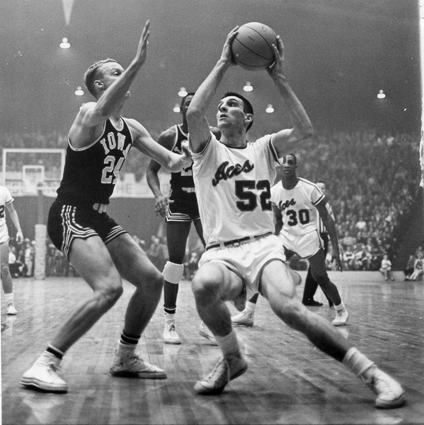
Plenty of schools that are now DI were classified as College Division in the ’60s, and Evansville College in Indiana was a national power in the smaller school division. Their coach, Arad McCutchan, had won the National Championship in ’59 and ’60 when Sloan was still in high school. McCutchan heard about Sloan’s quick exit at Illinois and offered him another chance, a full ride to Evansville—just 90 miles east of McLeansboro.
McCutchan was the coach at Evansville from ’46-77, and his Purple Aces would win five NCAA College Division Championships: 1959, ’60, ’64, ’65 and 1971. When McCutchan retired, he and John Wooden were the only two coaches in NCAA history to win at least five NCAA titles. Sloan played well in Evansville, winning two of those NCAA titles in ’64 and ’65. (Sloan likes to stress that he didn’t score as many points as his teammate, Larry Humes.) And despite its remote location, Evansville was No. 6 in the nation in attendance when Sloan starred.
Arad McCutchan was quite a character. He liked to point out that his first name was Biblical and meant “Wild Ass” in Arabic (Some interpret it as “Wild Ox” in Hebrew.) He gave Sloan plenty of more serious things to ponder.
“He taught us manners,” Sloan says. “How to use a knife and fork properly, how to handle yourself in the world. And I’d never done any public speaking at all.” McCutchan fixed that: Anytime the popular Purple Aces appeared at a local banquet, Elks Club or media function, each team member had to stand up and introduce a teammate to the audience. That was precisely the kind of responsibility to the team that would define Sloan’s playing and coaching over the years.
McCutchan had a peculiar omniscience about Sloan’s future. After his sophomore season, the coach cornered Sloan: He wanted his star to return as the head coach at Evansville. “In 10 years,” Sloan remembers being told, “after you’re done playing in the NBA.”
Becoming a college coach? After a decade in the NBA? Sloan hadn’t given those options any thought. But now, as a mere undergraduate, he couldn’t get either out of his head.
Sloan was spotted at Evansville by a young Baltimore Bullets scout named Jerry Krause at the national tournament his junior year. The Bullets drafted him fourth overall, and he had a decent rookie year in Baltimore. Sloan became the “Original Bull” when he was selected by the newly formed franchise in the ’66 expansion draft. The Bulls struggled their first few years, although Sloan played well enough to be selected for two NBA All-Star Games.
The NBA had tried teams in Chicago before that: the Chicago Stags, Packers and Zephyrs all failed in the large Midwest market. But they didn’t have Jerry Sloan. Or WGN, for that matter.
Three transactions the Bulls made would have an enormous and lasting impact on the franchise—and on Sloan’s career.
First, in 1968, the Bulls hired Dick Motta as coach. Within three years, the Bulls were 51-31, despite not having the then-necessary Hall of Fame center to compete.
Second, in 1971, the Bulls picked up Norm Van Lier from the Cincinnati Royals. Just 6-1, Van Lier led the NBA in assists the previous year, in addition to scoring 16 points a game.
Third was a less-publicized acquisition the Bulls made before that 1971 season. Motta hired Phil Johnson, who’d played for him in junior high and high school, to be his assistant.
With Sloan and Van Lier in the backcourt, the Bulls improved to 57-25 in the 1971-72 season; the Bulls were consistent 50-game winners until 1975, with Sloan averaging close to 15 ppg over that stretch.
As usual, though, the stats don’t tell the whole story. Motta brought a tough, grind-it-out style that suited the Bulls—and the City of Big Shoulders. Forwards Bob Love and Chet Walker were the top scorers. Center Tom Boerwinkle couldn’t jump over a Chicago phone book, but he dished out assists like Christmas presents at the orphanage—which was precisely where the grit-over-glamour Bulls practiced in those days.
But the boiler room of that team was in the backcourt, and in Van Lier, Sloan found his alter ego. Van Lier played with a furious anger. And like Sloan, he cared little about scoring. Winning—and it was often ugly—was everything. Sloan and Van Lier seemed to crave collisions on defense; the two were constantly taking charges, finding themselves horizontal in a very vertical world. Their knees and elbows were constantly swollen from crashing onto the hardwood.
In his typical understated style, Sloan says, “Norm and I were a good fit. I had tremendous trust in him. We were on the same page immediately, from the first time we practiced together.”
A knee injury ended Sloan’s career in ’76, and when McCutchan retired around the same time, it seemed the second part of his old mentor’s wish would came true: Sloan accepted the head coaching job at Evansville. But five days later, Sloan changed his mind, citing “personal reasons.” The mystery of why Sloan didn’t go back to Evansville remains, as he still cites the same “personal reasons” when asked why he never coached his old school. Eerily, the Evansville team went down in a plane crash that same season, killing everyone on board.
Instead, Sloan joined the Bulls as a scout that season and soon became an assistant coach. Then, in ’79, the Bulls named him their head coach. Three coaches before Sloan had failed in quick succession to get the Bulls up to Motta’s standard.
Sloan would fall short, too. In less than three years, his teams were 94-121. They qualified for the Playoffs in his second year, but the franchise fired their Original Bull early the next year. Yet, in talking about decisions he made as a young Bulls coach, Sloan shows both the stubbornness that made him a great player and the confidence that allowed him to succeed at his second stop. “I wouldn’t have done anything differently coaching the Bulls,” he says today.
And once again, after getting knocked down, like Sloan did in his aborted playing career at Illinois, he would come back stronger, better prepared. Although this time the transformation would take a few years. That was all right. He never seemed to be in any hurry.
The Utah Jazz hired Sloan as a scout, then as an assistant coach to Frank Layden. Seventeen games into the ’88-89 season, Layden retired and the team named Sloan as their head coach. Old friend Phil Johnson was named his assistant.
Stop for a moment to consider the long arc of Sloan’s great success over 23 years with Utah: He became the Jazz head coach three months before Blake Griffin was born. During the years he coached the Jazz, there were 245 coaching changes in the NBA. And five current NBA teams (Charlotte, Memphis, Toronto, Orlando and Minnesota) did not even exist when Sloan took over in Utah.
Today he’s third all-time in NBA wins (1,221) behind Don Nelson (1,335) and Lenny Wilkens (1,332). By 2002 he was the longest tenured coach in any major professional sport, and he obviously still was when he retired abruptly last spring.
And Sloan is one of just three coaches in the League’s history to notch 15 or more consecutive seasons with a winning record. (Pat Riley and Phil Jackson are the others.)
How about this stat? Jerry Sloan holds the record for most consecutive games with the same team: 1,673. Second place? Red Auerbach, with 1,192.
In our fast-changing, high-tech society, Sloan is practically the definition of “Old School.” And sure, there are a lot of old-school coaches, but nobody who has won as consistently in such a—well, such an obscure place. In an era of free agency, when a lot of players (and coaches) might as well have WHERE’S MINE tattooed on their shoulders, Sloan is like a human throwback jersey. In a world that values hipness and cool and street cred, Sloan is the anti-trend, the coach in a John Deere hat.
But when asked about today’s player and the typical NBA mentality, “What they consider hard work and what I consider hard work are two different things,” is about as critical as he gets. It’s practically impossible to get Sloan to criticize players, past or present.
This is the guy who married his high school sweetheart and stayed with her for 41 years, until cancer took her away. He never even had an agent, and every contract he signed was a one-year deal.
And winning consistently in Utah? How hard it is to attract players and win in a minor market like that?
Here’s a great irony: Sloan was not only the NBA’s longest-tenured coach. He was also the least decorated. He has never won the NBA’s Coach of the Year award, although Johnson, the assistant who rode shotgun on Sloan’s long ride, won it. Do you think that bothers Sloan? Hardly. Instead, he wants to talk about the coaches he learned so much from as a player and assistant. Not just McCutchan and Motta, whom you’d expect. Sloan insists on mentioning, in very specific detail, all he learned from Paul Seymour, Johnny “Red” Kerr, his high school coach Haile, Ed Badger, Scottie Robertson, Larry Costello and, of course, Frank Layden.
In 2001, long before he wrote the book Glory Road, writer Dan Wetzel made his case on CBS.com for Don Haskins as the greatest college basketball coach of all time. Haskins was the winner of a single NCAA title, but Wetzel argued that he’d won a huge number of games in El Paso, a city and mid-level job where the other names on his list—Adolph Rupp, Mike Krzyzewski, John Thompson, Henry Iba, Bobby Knight, Dean Smith and John Wooden—would never have even considered coaching.
I’ll suggest a similar possibility here, although Jerry Sloan will be embarrassed and appalled: He may have been our best NBA coach ever. As great as Auerbach, Phil Jackson, Pat Riley, Don Nelson or Lenny Wilkens were, Sloan was winning consistently in Utah. And despite having Stockton and Malone (they still sound better as Stockton to Malone, don’t they?), Sloan won with castoffs, also-rans and a less-than-stellar roster over 23 years in our most remote NBA city.
No, Jerry Sloan won’t like that suggestion. It will feel awkward, just like it felt as an out-of-place farm kid at a Big Ten school. As out of place as a fancy fedora would be on him. Still, over time, he might have to get used to it.
—
Rus Bradburd was an assistant coach at UTEP from 1983 until 1991. Now an assistant English professor at NMSU, he’s the author of “Forty Minutes of Hell: the Extraordinary Life of Nolan Richardson.” His first book of fiction, Make It, Take It, will be released in January of 2013.